Research and Scholarly Work
My current research focuses on knowledge management, systems thinking and engineering, design thinking, program management and management of innovation. I particularly look at:
- How knowledge of the technical, business and operational environment can improve systems design and safety
- How our knowledge of complex systems can be understood to improve operations and safety
- How large innovation projects can be managed
- How knowledge gained through scientific endeavors can be commercialized into innovative solutions.
Past Research Projects
Over the years, I have worked inv various domains, mainly applying computational modelling to complex systems and processes. You can see some of the past projects I have worked on at the linked below.
Lunar Accidents, Incidents and Issues Reporting System (LAIIRS)
LAIIRS
Planning as Inference in Epidemiological Models
ITN WALL: Micromagnetic simulation and analytical modeling of magnetic domain wall motion in nanostructures
Summary
Under the Marie Curie Initial Training Network (ITN) WALL, I worked on the project “Analytical modelling of magnetic domain wall dynamics” at the Collective Phenomena in Physics & Materials Science group at ISI Foundation. In parallel, I completed a PhD in Physics at the Politecnico di Torino. 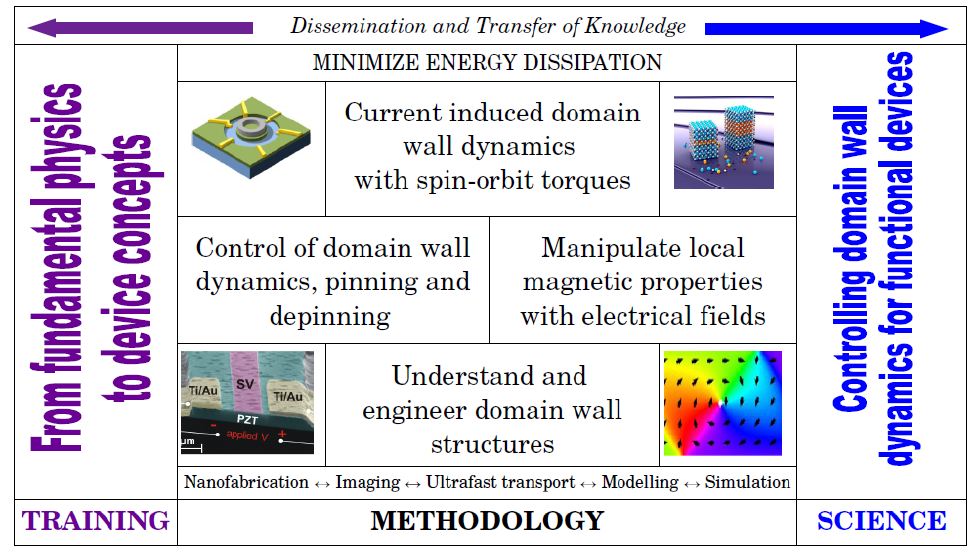
About the Project
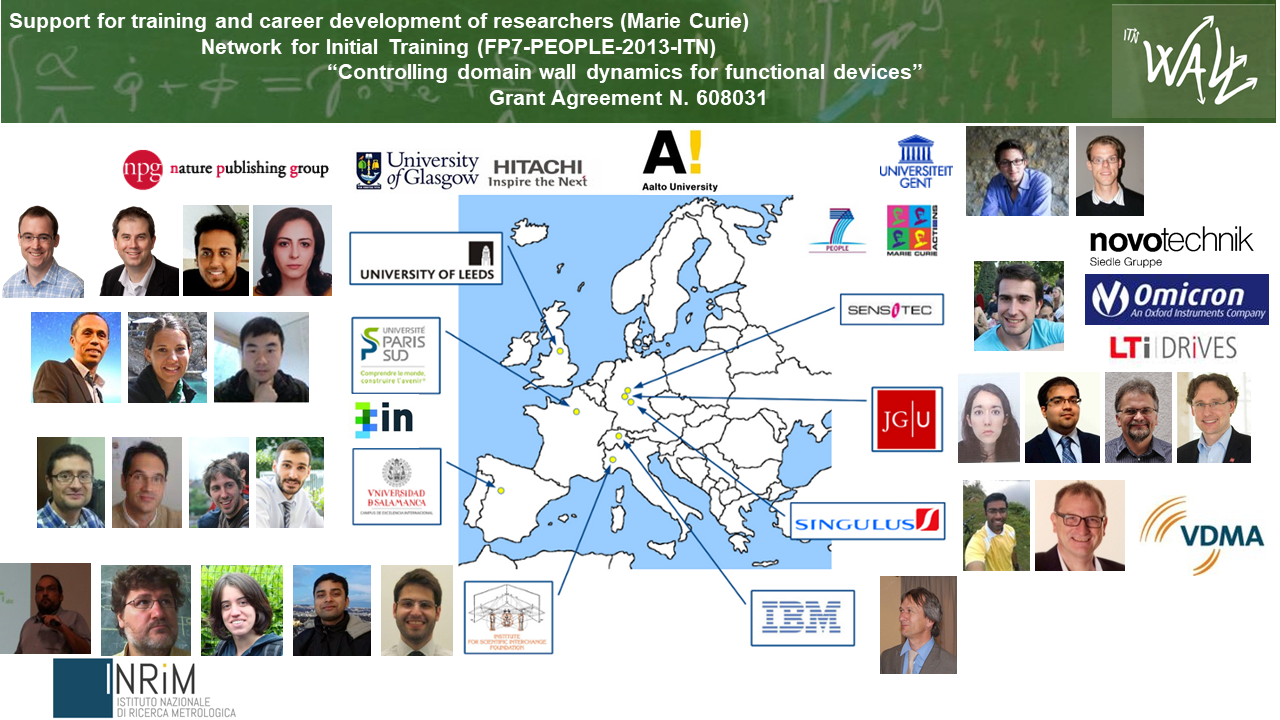
ITN-WALL was created to study magnetic domain walls (DWs), the interfaces separating magnetic domains. Manipulation of these in nanostructures may lead to the next generation of new and low power functional devices for computation and communication. The project had 7 main partners and 12 associate partners from Italy, Germany, France, the UK, Belgium, Spain and Switzerland. My role was to use model reduction to come up with simplified models to describe the dynamics of magnetic domain walls. I extended the collective coordinate approach based on a Lagrangian-formulation to include phenomena important in domain wall motion in perpendicular magnetic anisotropy heterostructures with the Dzyaloshinskii-Moriya interaction under the application of in-plane fields, out of plane magnetic fields, and currents. I also used micromagnetic simulations to perform more detailed studies on these systems. As part of this project, I also collaborated on other projects including:
- Collaboration with Ghent University on the development and comparison of a semi-analytical collective coordinate model derived from statistical methods
- A one month research stay at the University of Salamanca to study domain wall motion under in-plane fields, and the effect of local anisotropy variation on domain wall motion
- A one month research stay at University of Paris Sud-Paris Saclay CNRS (cut short due to flooding in Paris)
- A two week stay at IBM Research Zurich where I studied the structure of anomalous domain walls, and performed micromagnetic studies on magnetic tunnel junctions
- Regular visits to the National Metrological Institute of Italy (INRiM)
Achievements
- Development of extended collective coordinate models for the analysis of magnetic domain wall motion under magnetic fields and currents
- Contribution to the study of creep phenomena in magnetic systems through numerical simulations in Mumax3
- Publication of 6 peer reviewed papers and presentation of 13 talks and 15 posters at international conferences
- Organization of the Second Marie Curie School on Domain Walls and Spintronics held in Spetses, Greece.
Select Publications
- S. A. Nasseri, E. Martinez G. Durin “Collective Coordinate Descriptions of Magnetic Domain Wall Motion in Perpendicularly Magnetized Nanostructures under the Application of In-plane Fields”, Journal of Magnetism and Magnetic Materials, vol. 568, pp. 25-43, 2018, doi: 10.1016/j.jmmm.2018.07.059.
- B. Sarma, F. Garcia-Sanchez, S. A. Nasseri, A. Casiraghi, G. Durin, “Dynamics and morphology of chiral magnetic bubbles in perpendicularly magnetized ultra-thin films with the Dzyaloshinskii-Moriya Interaction”, Journal of Magnetism and Magnetic Materials, vol. 456, pp. 433-438, 2018, doi: 10.1016/j.jmmm.2018.01.075.
- J. Vandermeulen, S. A Nasseri, B. Van de Wiele, G. Durin, B. Van Waeyenberge, and L. Dupre, “Comparison between collective coordinate models for domain wall motion in PMA nanostrips in the presence of the Dzyaloshinskii-Moriya interaction”, Journal of Magnetism and Magnetic Materials, vol. 449, pp. 337-352, 2018, doi: 10.1016/j.jmmm.2017.10.008. [Joint First Author]
- S. A. Nasseri, S. Moretti, E. Martinez, G. Durin, C. Serpico, “Collective Coordinate Models of Domain Wall Dynamics in PMA Materials under Spin Hall Effect and Longitudinal in-Plane Fields”, Journal of Magnetism and Magnetic Materials, vol. 426, pp. 195-201 , 2017, doi: 10.1016/j.jmmm.2016.11.081.
- J. Vandermeulen, S. A. Nasseri, B. Van de Wiele, G. Durin, B. Van Waeyenberge and L. Dupre, “The effect of the Dzyaloshinskii-Moriya interaction on field-driven domain wall dynamics analysed by a semi-analytical approach”, Journal of Physics D: Applied Physics, vol. 49 (46), no. 465003, 2016, doi:10.1088/0022-3727/49/46/465003.
- S. A. Nasseri, B. Sarma, G. Durin, C. Serpico, “Analytical Modeling of Magnetic Domain Wall Motion under Applied Fields and Currents”, 20th International Conference in Magnetism, Barcelona, July 2015 (Published in physics procedia, vol. 75, pp. 974-985), doi: 10.1016/j.phpro.2015.12.133.
Space4Health
Summary
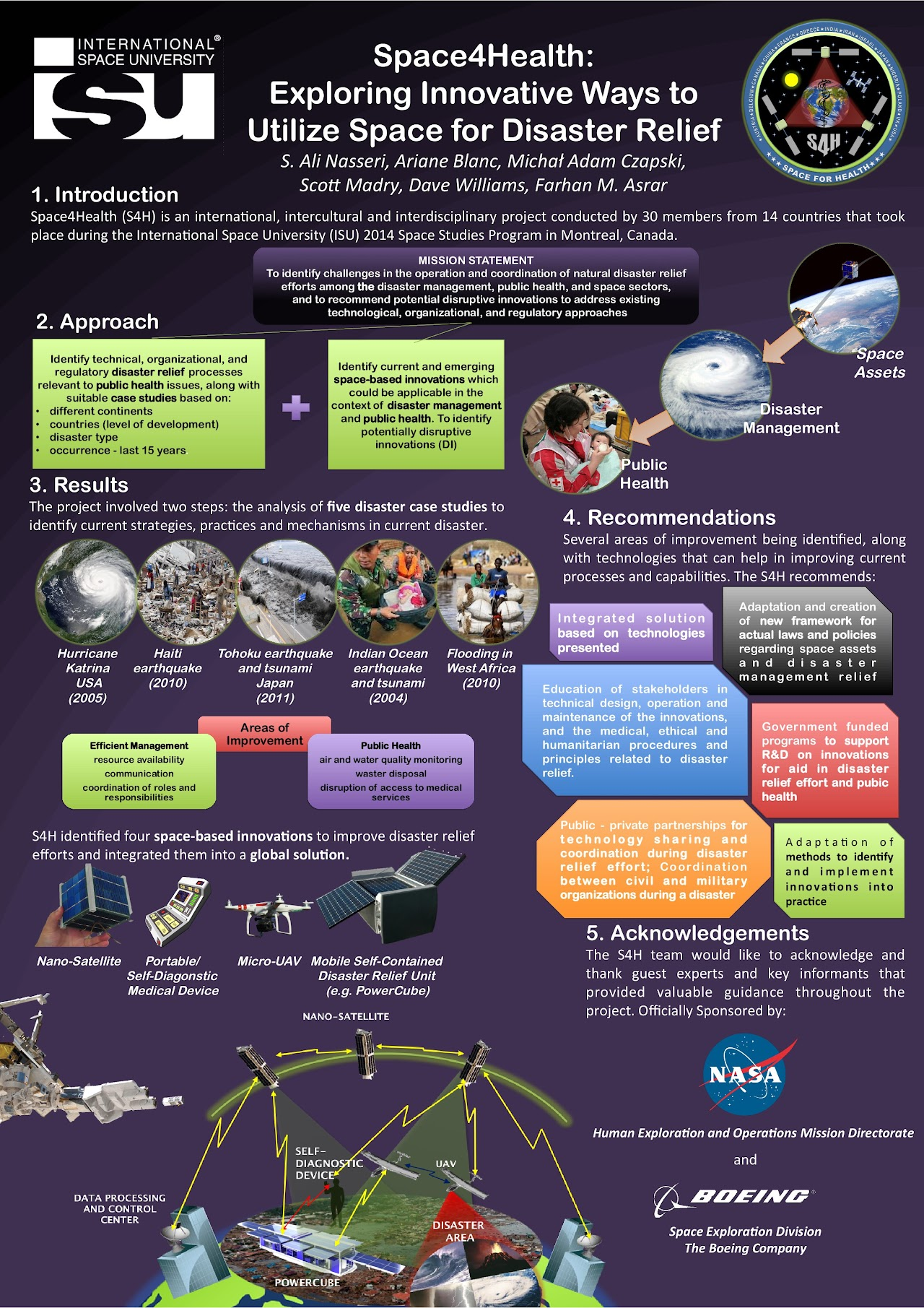
The S4H project focused on the use of space applications to support public health during and after natural disasters. In the context of this project, I managed and facilitated the activities of a team of 30 international students and professionals from 14 countries during the SSP.
About the Project
As part of the Space Studies Program 2014, a team project was proposed focused on Space for Public Health. In this context, a team of about 30 international individuals were put together to develop a project around this broad topic.
After many discussions, the group decided to focus on use of disruptive innovation (from but not limited to space) in support of public health during natural disasters. We had 3 weeks to put our idea together into a coherent whole which we successfully did.
The concept relies on an integrated solution based on the following assets:
- Space assets in the form of nanosattelite used for observation and communication
- Mobile ground segments as a means of providing a hub for data collection, processing and communication while at the same time providing a local source of aid
- Swarms of robots used for local exploration of disaster regions and identification of site safety
- Wearables as a means of tagging identified victims and monitoring their vitals at the disaster site
The concept was generally well received and featured on the cover of the Journal for Disaster Medicine and Public Health Preparedness.
Achievements
- Presentation of a novel integrated approach to manage assets available during disasters to promote public health and safety
- One journal publication in the Journal of Disaster Medicine and Public Health Preparedness which reached the cover of the journal
- A report along with presentations and conference papers for IAC 2014, RAST 2015 and a short article for Space Times on our ideas
- Extension of the concept to monitoring public health effects of hydraulic fracking
Select Publications
- Farhan M. Asrar, Annie Hui Wen, S. Ali Nasseri, Petros C. Dinas, Cory Newman, Angie Bukley, Kevin Crist, Dennis Irwin, “Space technologies for monitoring health and environmental impact of hydraulic fracturing”, The Lancet Planetary Health, vol. 2, issue 11, pp. e469-e470, 2018, doi: 10.1016/S2542-5196(18)30223-7. [joint first author]
- P. C. Dinas*, C. Mueller*, N. Clark*, T. Elgin*, S. A. Nasseri*, E. Yaffe*, J. B. Clark, S. Madry and F. M. Asrar, “Innovative Methods to Benefit Public Health Using Space Technology During Disaster Relief”, Journal for Disaster Medicine and Public Health Preparedness, vol. 9 (3), pp. 319-328, 2015, doi: 10.1017/dmp.2015.29. [joint first author, paper highlighted on the cover of the journal, and received dedicated editorial]
SGAC Space Safety and Sustainablity Project Group
Summary
I initially joined the SGAC Space Safety and Sustainability project group in 2012, and was given the privilege of leading the project group from 2014 to 2016. During this time, we worked on multiple projects including active debris removal, on-orbit servicing, applicability of space debris removal to small satellites, space suit safety, and risk analysis for a one way human mission to Mars.
During my term as co-lead, 11 total projects were pursued by the SSS team, and through the introduction of a new proposal process for pitching new projects. These projects led to a total of more than 22 contributions in the form of papers, reports and presentations.
About the Projects
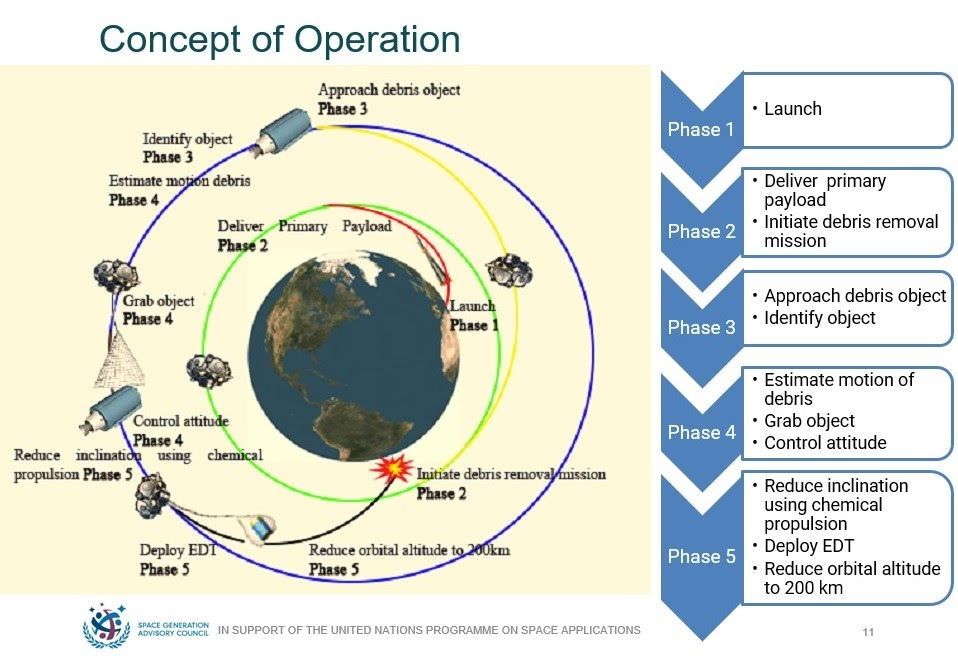
1. Active Debris Removal Using Modified Launch Vehicle Upper Stages
In this project, we proposed an approach to remove space debris from polar earth orbits using modified launch vehicle upper stages. The maneuvers needed and the economics of such an approach were analyzed, along with the safety of passive or active deorbiting.
2. On-orbit Servicing
We analyzed the concept of on-orbit servicing and the importance of standardization in this realm. We also performed mission analysis for one mission concept to better understand the economic aspects of on-orbit servicing missions.
3. Nuclear Power Sources in Space
We provided recommendations from students and young professionals on this topic to the UN COPUOS Scientific and Technical Subcommittee.
4. On Way Human Missions to Mars
We analyzed the risks associated with a one way human mission to Mars, highlighting some of the reasons why such missions might not be a good idea.
Achievements
- Proposed and analyzed a mission for active space debris removal using modified launch vehicle upper stages
- Developed policy recommendations on the need for standardization in order to enable on-orbit servicing
- Analyzed mission concepts for future on-orbit servicing missions
- Proposed recommendations on the use of nuclear power sources in space
- Analyzed risks associated with a one-way human mission to Mars
Selected Publications
- S. A. Nasseri, M. Emanuelli, “SGAC Space Safety and Sustainability Project Group - Reflecting the Views of the Next Generation for Five Years”, 7th International Conference on Recent Advances in Space Technologies (RAST), Istanbul, June 2015, doi: 10.1109/RAST.2015.7208404.
- A. Rivolta, J. Wang, C. Thro, N. Carletti, S. A. Nasseri, J. Lousada, M. Emanuelli, “Analysis on spacecraft safety enhancement through on-orbit servicing”, 8th IAASS Conference, Melbourne-Florida, 2016, doi: 10.13140/RG.2.1.4029.9922.
- J. Lousada, A. Rivolta, M. Emanuelli, S. A. Nasseri, “Identification of Hazards Associated with a One-way Human Mission to Mars”, 8th IAASS Conference, Melbourne-Florida, 2016.
- C. Dubois, L. Bacsardi, M. Deiml, A. Kumar, S. A. Nasseri, A. Bartolini, J. Todd, K. Howells, “Policy Considerations for New Human Space Exploration Strategies: The Space Generation Perspective”, International Astronautical Congress 2015, Jerusalem, October 2015.
- D. E. Chiuri, A. Turconi, A. Hussein, N. Nader, S. Raval, M. Emanuelli, S. A. Nasseri, “Active Debris Removal: Overview and Figures of Merit of Debris Grabbing Strategies”, International Astronautical Congress 2015, Jerusalem, October 2015.
- S. A. Nasseri, M. Emanuelli, S. Raval, A. Turconi, C. Becker, “Active Space Debris Removal using European Modified Launch Vehicle Upper Stages equipped with Electrodynamic Tethers”, 6th European Conference on Space Debris, April 2013 (ESA SP-723) [link].
- D. P. Patel, A. Martin, S. W. Chiu, J. Lousada, A. Rivolta, S. A. Nasseri, “National research on space debris, safety of space objects with nuclear power sources on board and problems relating to their collision with space debris”, Committee on the Peaceful Uses of Outer Space Scientific and Technical Subcommittee Fifty-third session Vienna, 30 January -10 February 2017 (A/AC.105/C.1/111).
Surrogate Mixture Formulation for Aerospace Fuels
Summary
From 2010 to 2012, I worked at the Combustion and Propulsion Group at the University of Toronto under the supervision of Professor Omer L. Gulder on a project to develop surrogates for aerospace fuels. Surrogates are chemical mixtures that have similar properties to the sample of interest in some regards.
About the Project
Fuels are key elements of combustion systems. The variability in composition of real fuels and the large number of components these fuels are composed of, limit their use for experimental and numerical modeling of combustion systems. To overcome these limitations, surrogate fuels may be used.
Surrogate fuels are mixtures of pure hydrocarbons that mimic specific properties of a real fuel. The use of a small number of pure compounds in their formulation ensures that chemical composition is well controlled and numerical modeling has lower computational cost.
In this work, surrogate mixtures were developed for Jet A fuel based on correlations between fuel properties (cetane number, smoke point, threshold sooting index (TSI), density, viscosity, boiling point and freezing point) and the nuclear magnetic resonance (NMR) spectra of the fuel as a measure of the fuel’s chemical composition. Comparison of the chemical composition and target fuel properties of surrogate fuels developed in this work to a Jet A fuel sample and other surrogate fuels proposed in the literature revealed the superiority of these surrogate fuels in mimicking the fuel properties of interest.
Achievements
- Mathematical models/quantitative structure property relationships (using regression methods and machine learning techniques) to correlate ignition quality, sooting tendency and thermophysical properties of different hydrocarbons with the chemical structure of the fuel (represented by NMR spectra)
- Proposal of surrogate mixtures that could mimic the properties of Jet-A fuel using NMR spectrum matching and the correlations developed (lumped parameter modeling)
Publications
Space Launch and Propulsion Modelling
Summary
During my undergraduate studies, I worked at the Multidisciplinary Design Optimization Lab (later Space Launch Research Centre) at K. N. Toosi University of Technology from 2007 to 2010, working on developing optimization tools and system models for preliminary sizing of space launch systems. I did an internship at the Space Systems Research Center (SSRC) at KNTU, where I worked on the preliminary sizing of liquid propellant rockets. This led to my undergraduate thesis on the preliminary sizing of launch vehicles, titled “A Computational Model for the Conceptual Design and Preliminary Sizing of Multistage Expandable Space Launch Vehicles”.
Achievements
- Development of an Ant Colony Optimization code and applying it to launch vehicle conceptual design models available at the lab
- Development of a 3-DOF flight simulation code for trajectory analysis of space launch vehicles
- Development of a liquid propellant rocket engine conceptual design program
- Web-editor for the group website
Publications
- S. A. Nasseri, “Development of an Algorithm and a Program for the Conceptual Design and Preliminary Sizing of Multistage Expendable Launch Vehicles”, Undergraduate thesis/project report, K. N. Toosi University of Technology, September 2010.
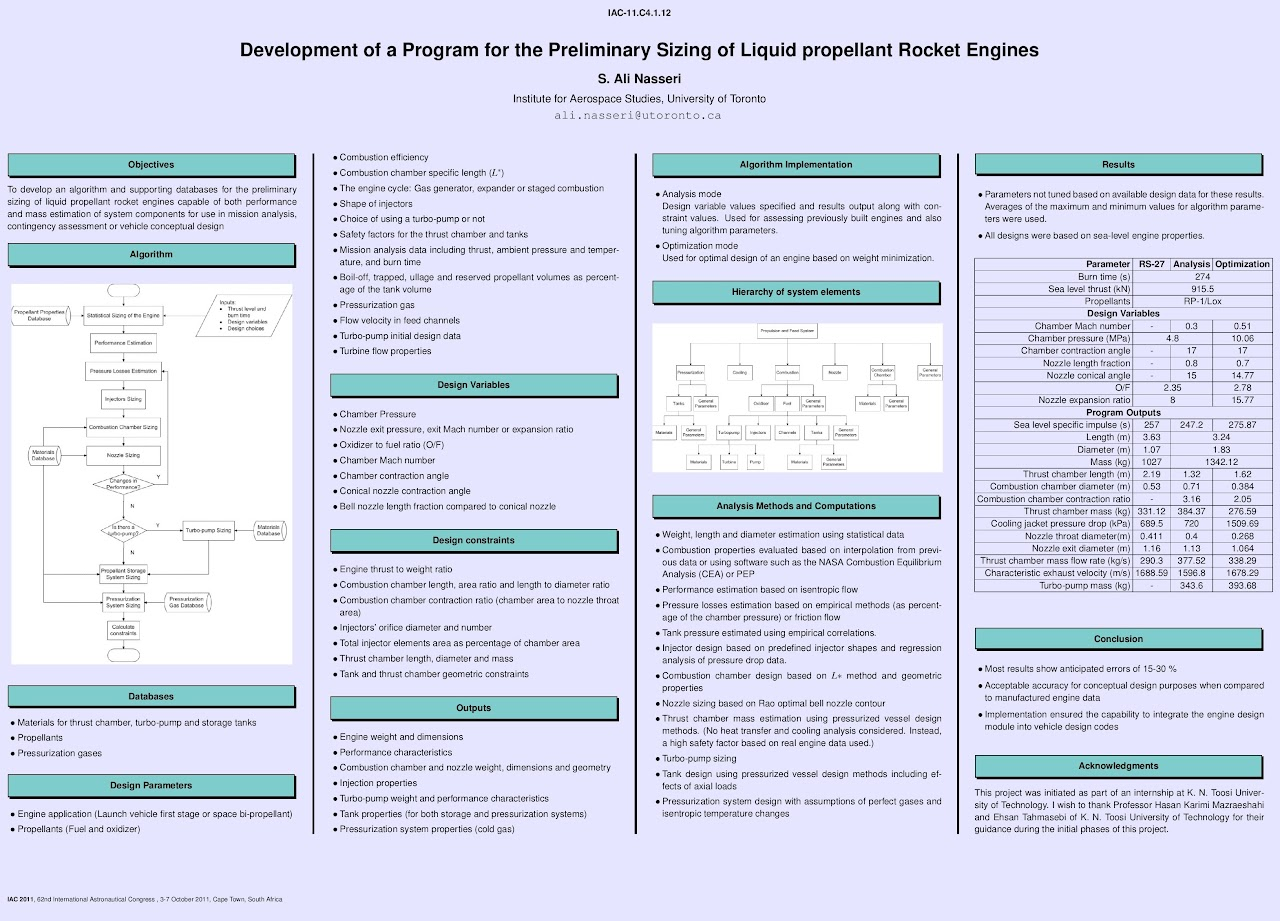
- S. A. Nasseri, “Development of a liquid propellant rocket engine conceptual design and preliminary sizing program for use in the design of aerospace vehicles”, Proceedings of the 62nd International Astronautical Congress, Cape Town, October 2011.